Guide
Pet Grooming Prices: What to Charge & How to Raise Your Rates
What to charge for dog grooming, how to price by size and coat, and how to raise your rates without losing the clients worth keeping — a practical guide.
Ask a room of experienced groomers what they'd do differently, and the answer is nearly unanimous: they'd have charged more, sooner. Not marketed harder. Not bought better clippers. Priced higher.
This guide is the practical version of that advice. What to charge, how to build a price from your actual costs, how to price fairly by size and coat, and how to raise your rates without the confrontation you're dreading. It's written for the groomer who already suspects they're undercharging but is scared of what happens if they change it.
Why almost every groomer starts too low
Underpricing is the single most common regret in grooming. When we asked 194 groomers what they wish they'd known before opening, pricing came back more than any other theme — ahead of marketing, equipment, and hiring combined.
The reason it tops every list is that underpricing compounds. Every other problem in a young grooming business gets harder to solve when the margin is too thin:
- You can't buy the hydraulic or lift table that saves your back — and your back is your business.
- You can't afford insurance, a proper bookkeeper, or a single day off.
- You can't say no to the aggressive dog or the chronically late client, because you need the money.
- And once your clients have anchored to a low price, every increase becomes a fight you have to win over and over.
One groomer, 20-plus years in, put the scale of the fix bluntly:
You know that number in your head you need to hit to make a decent income? Triple it.
Rachelle M.
Another described the alternative — running a full salon while quietly going broke:
I did a big salon for a couple of years, then went back to doing it alone. I couldn't keep my doors open and pay myself too.
Amanda G.
Here's the part most pricing advice misses: underpricing usually isn't a math mistake. It's a fear that shows up on the price list. Fear that nobody will book you. Fear that you're not "worth it yet." Fear of losing the price-shopper. The low number is the symptom. We cover the mindset side in depth in why you don't have a pricing problem, you have a positioning problem — this guide handles the numbers.
How much should you charge for dog grooming?
Most new groomers set their price by looking at the shop down the road. It's the wrong anchor — but it's the question everyone asks first, so let's answer it, then fix it.
The ranges below are typical reported US prices, meant only to orient you. Grooming prices vary enormously by region, coat, temperament, and the experience you offer — a rural Midwest town and central Austin are not the same pricing environment.
| Service | Small dog | Medium dog | Large dog |
|---|---|---|---|
| Bath & brush | $25–40 | $35–55 | $45–75 |
| Full groom / haircut | $40–65 | $60–90 | $80–130 |
| De-shedding treatment | $45–65 | $65–95 | $90–140 |
| Doodle full groom | $75–110 | $100–150 | $130–200+ |
Two things to notice.
First, the range within each cell is huge — a large-dog full groom spans $80 to $130. That gap is the pricing power. The groomers at the top of it aren't doing a different haircut; they're offering a different experience.
Second, the market is not your ceiling. One groomer described what happens when you stop competing on price:
Just because everyone else in town is dirt cheap doesn't mean you need to be. My prices are now almost double compared to others, and I'm booked out 9 weeks.
Kaley Z.
There's a sane counterweight, and it belongs here too:
I agree don't undercharge — but also don't overcharge. Keep prices reasonable so clients can come more often. That's a win for you, the customer, and the dog.
Sharon E.
The resolution to both is the same: stop pricing off the shop down the road, and start pricing off your own costs.
How to actually set your price
Here is the method that experienced groomers back into after years of undercharging. Do it on purpose from the start.
Start from your costs and the income you want — not the market. Add up everything it costs to open your doors for a month: rent, insurance, supplies, utilities, software, and equipment spread over its life. Then add the income you actually want to take home. Divide by the realistic number of grooms you can do in a month — not your best week, your sustainable average.
That number is your floor. No price below it is a business; it's a job you're subsidizing.
Once you have your floor, then look at the local market — as a sanity check, not a source:
- If your floor lands 15–25% above the local average, good. That's where a professionally-run solo groomer usually belongs.
- If it lands below the average, either your target income is too low or your appointment-volume assumption is unrealistic.
- If it lands well above what your market can bear, you either raise what you offer (specialty coats, senior dogs, breed-correct cuts) or you're in the wrong market.
One owner shared the only clean formula in the whole thread — a useful gut-check once you're running:
Pay is 33% employee, 33% owner, 33% business. Never give away 50% to a partner who didn't put in 50%.
Debbie P.
Pro tipMobile and house-call groomers should build a travel or convenience premium into every price — you're selling the client's saved time as much as the groom, and your day fits fewer dogs. We cover the arithmetic in what to charge for drive time.
Running these numbers by hand is where most groomers give up. Don't — that's exactly what the calculator is for.
Pricing by size, coat and breed
A matted doodle and a smooth-coat pug should never cost the same, yet flat-rate pricing is everywhere because it's simpler to quote. That convenience is costing you real money on every hard groom.
Price the base groom by size and coat, then add for the work:
- Coat condition — matting, density, length beyond standard.
- Behavior — a dog that needs two people or twice the time.
- Size beyond standard — the 90-pound doodle is not a "large."
- Time — some grooms simply take longer; charge for it.
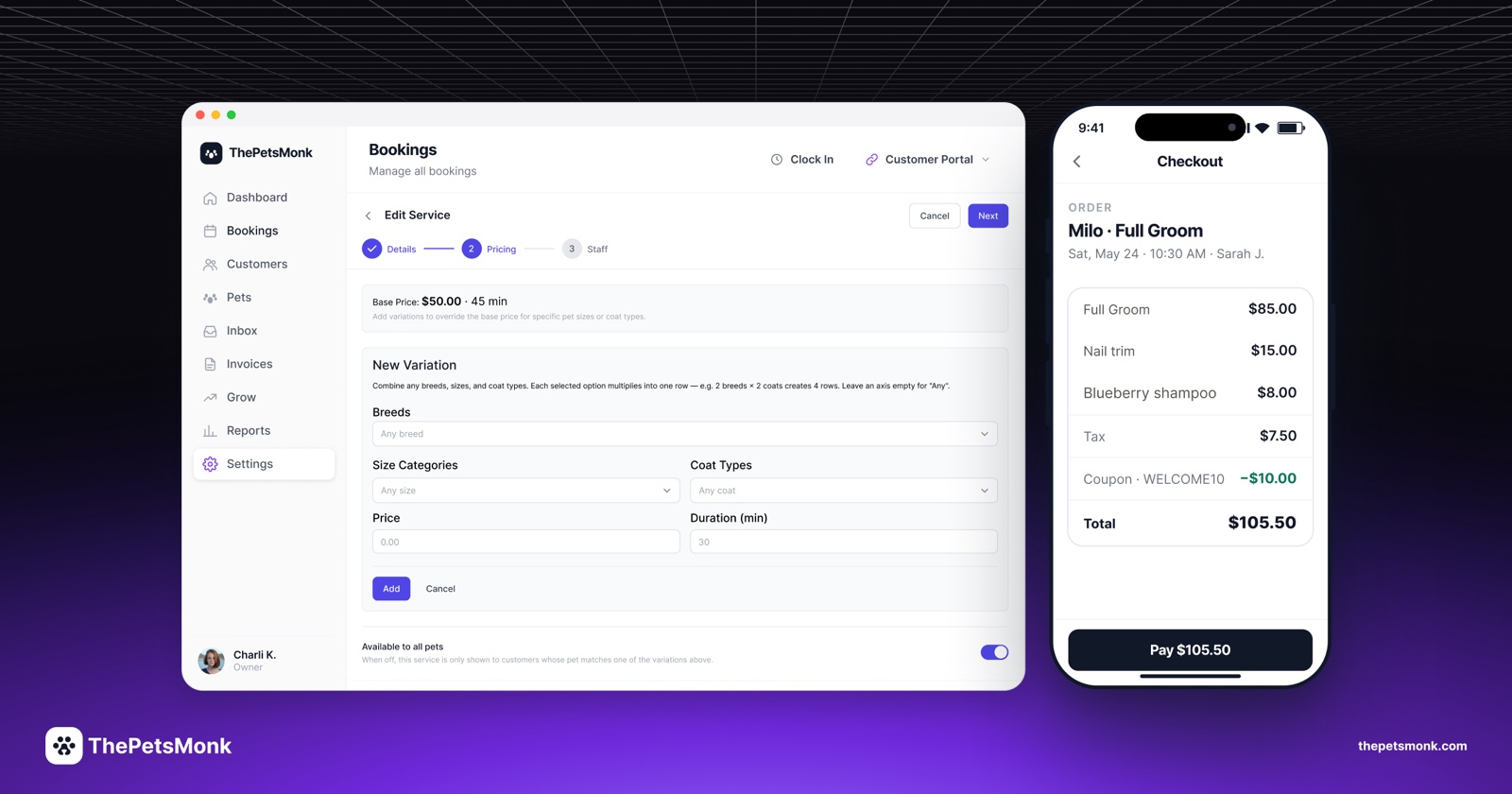
The trick that makes this stick: put the add-ons on your intake form so the client sees them before you touch the dog. That does two things. It stops you absorbing the cost of every difficult groom — and it removes the single hardest moment in grooming pricing: quoting a higher number out loud, at the counter, to someone's face. That moment is where people-pleasers cave and hand out discounts they never meant to give.
Pro tipWrite your add-on prices down once, on the intake form, and never negotiate them at the counter. The groomer who quotes matting fees verbally is the groomer who "forgets" to charge them.
Two coats break a standard price list badly enough to need their own numbers: doodles and heavily matted coats. We cover the three de-matting fee models, how to grade matting so the fee isn't arbitrary, and how to price a humane shave in what to charge for doodles and matted coats.
The other category that breaks it is the dog itself rather than the coat — seniors, giant breeds and special-needs dogs, where a two-to-three-hour appointment caps how many dogs your day can hold. That one is priced from capacity, not from the haircut: what to charge for senior, giant and special-needs dogs.
Booking software that calculates the correct price by size, coat, and breed automatically at booking takes that emotional labor off you entirely — the client picks their dog and sees the right price, before anyone has to have a conversation about it. That's the real reason to configure pricing rules in your online booking: not admin, but never having to argue about money at pickup.
Deposits, no-shows and the money leaking out the back
You can price perfectly and still bleed profit through an empty chair. No-shows and last-minute cancellations are the quietest way a grooming business loses money, and most owners never put a number on it.
Here's the number: a single missed $85 appointment costs more than a full month of most grooming software. Miss one a week and you're losing thousands a year to people who simply didn't show.
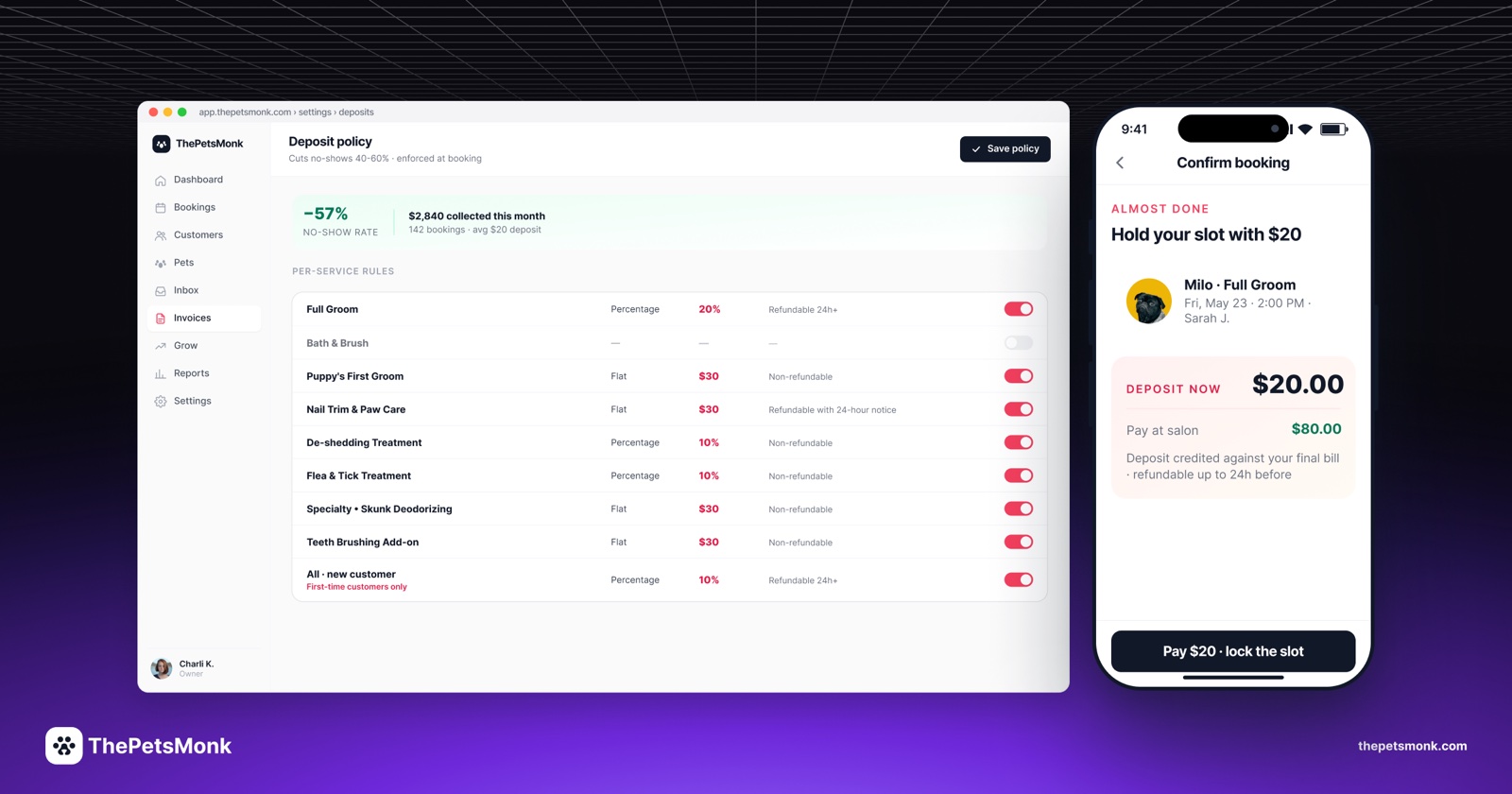
The fix is a deposit at booking — even a $20 non-refundable one. It does two jobs at once:
- It filters out tire-kickers and dramatically cuts no-shows.
- It signals professionalism. Real businesses take deposits; hobbies don't.
Pro tipDon't apologize for your deposit. The clients who balk at a $20 hold are the same ones who no-show. The deposit isn't a barrier to good clients — it's a filter against bad ones.
Pair it with a written cancellation policy that has actual teeth — 24 hours' notice, deposit forfeited or a percentage charged for no-shows — and enforce it every single time. A policy you don't enforce is just a suggestion. Deposits and stored cards make enforcement automatic instead of a confrontation.
How to raise your prices without losing clients
This is the section you actually came for, because raising prices feels like betraying the clients who've been loyal. It isn't — but the how matters enormously.
Raise in small, regular increments. 5–10% every 6–9 months. Existing clients tolerate small, predictable increases far better than a sudden 30% jump after three years of holding steady. Regular small raises also train your client base to expect that your pricing reflects a real business.
Announce it in advance, by text and email. Never spring a new price at the counter. Give 30 days' notice.
Frame it around what the client gets, not your rising costs. "More one-on-one time per appointment," "better products," "continued availability" — not "my rent went up."
Accept that you'll lose a few — the right few. The clients you lose to a 10% increase are almost always the ones who were costing you the most: the price-arguers, the chronic reschedulers, the ones who make the day worse. As one groomer put it after years of holding on to everyone:
I'm finally booked out enough that I'm weeding out the clients who don't bring happiness.
Brittan R.
How to write a price-increase letter to grooming clients
You don't need to agonize over the wording — you need a calm, confident message that states the change, gives a date, and points at what the client gets. Copy either template below, swap in your details, and send it 30 days before the new prices take effect.
Email template:
Subject: A small update to our grooming prices

Hi [First name],

A quick heads-up: starting [date], our grooming prices will increase by
[amount or %]. [Dog's name]'s full groom will move from [$old] to [$new].

This is the first adjustment we've made in [time period], and it lets us keep
giving [dog's name] the same unhurried, one-on-one appointment — no cage time,
no rushing — along with the products and care your dog is used to.

Your upcoming appointment on [date] is booked at the current rate. If you'd
like to get another one in before the change, just reply here or book online:
[booking link].

Thank you for trusting us with [dog's name] — it genuinely means a lot.

[Your name]
[Salon name]
Text-message template:
Hi [First name]! A quick note: our grooming prices go up slightly on [date] —
[dog's name]'s groom will be [$new]. It's our first change in [time period]
and keeps everything the same: one-on-one, no cage time, same great care.
Your [date] appointment is at the current price. Book here: [link]. Thank you! 🐾
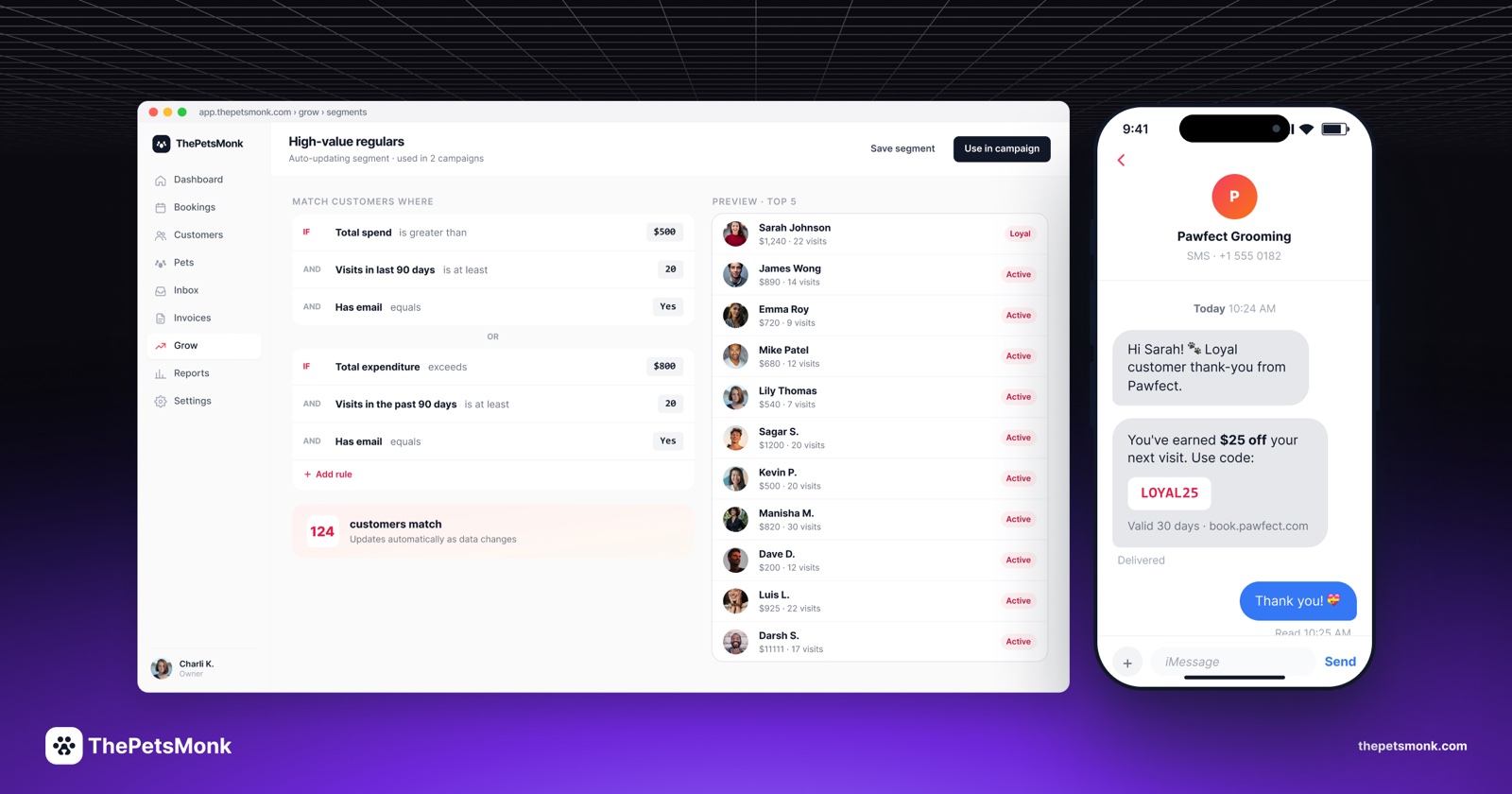
Two rules make these land: send them before the client hears the price at the counter, and never apologize. A confident, one-line reason ("our first change in two years") reads as professional; a paragraph of justification reads as guilt — and invites negotiation.
If you do get pushback — or the rare bad review after an increase — respond calmly, publicly, and once. We cover the full playbook for handling difficult clients in a dedicated guide. And if raising prices still feels like the hardest part of the job, the underlying problem is usually positioning rather than price.
The money that has nothing to do with grooming
The groomers in that thread were unanimous on one more thing: the business side blindsided them, and it quietly wrecks otherwise-good salons. If you price well but ignore this, you'll still end up broke.
Taxes are their own beast. Not one tax — several, and they surprise people every year:
All the taxes. Sales tax, employee taxes, annual taxes, business personal property taxes.
Natalie H.
The wrong help costs more than no help. Two warnings worth heeding:
Having the wrong accountant could cost you your business.
Lynnetta W.
My bookkeeper and CPA weren't strong in the service industry — which is different. I realized it in my third year and wish I'd found the right support sooner.
Denise M.
Get a bookkeeper who understands service businesses, know your overhead cold, and separate your business bank account from your personal one from day one.
And plan for retirement — because your body has a deadline. This is the vulnerability almost no pricing guide mentions, and it's the truest one. Grooming is physically finite. Groomers described career-ending back, neck, and shoulder damage after 15 to 30 years. That means the income you earn now has to fund the years when you physically can't do this anymore:
Save for retirement. You're going to need it.
Tonia B.
"Get yourself a pension," added another. If your prices don't leave room to save, they aren't high enough — full stop. This is the real reason "just charge more" is not greed. It's how a groomer funds the second half of a life the work is quietly shortening.
Frequently asked questions
How much should a dog groomer charge?
Set your price from your own costs and target income, not from the shop down the road. Add up your monthly overhead plus the income you want, divide by a realistic number of grooms per month — that's your floor. In most markets a well-positioned solo groomer lands 15–25% above the local average. Full grooms commonly run $40–65 for small dogs and $80–130+ for large dogs, but the range within each size is wide, and where you sit in it depends on the experience you offer.
What is the average price of dog grooming?
Typical US prices run roughly $25–75 for a bath and brush and $40–130+ for a full groom, depending on the dog's size and coat. Doodles and heavily matted coats cost more. These are orientation ranges only — actual prices vary widely by region, and pricing off the local average is how most groomers end up undercharging.
How do I price grooming by breed and size?
Set a base price by size and coat type, then add line-item charges for coat condition, behavior, over-standard size, and time. Put those add-ons on your intake form so clients see them before the appointment. Booking software that calculates the right price automatically by size, coat, and breed removes the awkward pricing conversation at pickup and stops you absorbing the cost of difficult grooms.
How often should I raise my grooming prices?
Every 6–9 months, in 5–10% increments, announced 30 days in advance. Small, regular, predictable increases are tolerated far better than a large jump after years of holding steady, and they train clients to expect that your pricing reflects a professional business.
How do I raise prices without losing clients?
Raise in small increments, announce in advance by text and email, and frame the change around what the client gets rather than your costs. Expect to lose a few clients — usually the price-arguers and chronic reschedulers who were costing you the most anyway. The clients worth keeping stay.
How do I write a price-increase letter to grooming clients?
Keep it short and confident: state the new price, give an effective date at least 30 days out, and tie the change to what the client gets — unhurried one-on-one appointments, the same products, continued availability. Don't apologize or over-explain, which invites negotiation. Send it before the client hears the price at the counter. Ready-to-send email and text templates are in the section above.
Should I charge a deposit for grooming appointments?
Yes. Even a $20 non-refundable deposit filters out no-shows and signals professionalism. A single missed $85 appointment costs more than a month of grooming software, so deposits — paired with an enforced cancellation policy — protect real revenue.
Why am I busy but not making money?
A full calendar can still hide thin margins. If you're booked solid and still broke, the usual causes are underpricing, absorbing the cost of difficult grooms, no-shows, and untracked overhead and taxes. Rebuild your price from your actual costs and target income rather than the local market, and the gap between "busy" and "profitable" starts to close.
See what your prices should actually be — in about two minutes, free.
Run your numbersGo deeper
What 194 groomers wish they knew
The regrets experienced groomers name most — pricing tops the list.
You don't have a pricing problem, you have a positioning problem
Why customers pay a premium — and how to earn it before the first snip.
Matted dog grooming: what to charge
The three de-matting fee models groomers actually use.
Senior dog grooming: what to charge
Pricing the appointments that reshape your whole day.
Mobile vs salon pricing: what to charge for drive time
Why the mobile premium is a subtraction, not a markup.
How much do dog groomers make?
Why the salary sites and the federal data disagree by 50% — and which number is yours.
Is dog grooming profitable?
Revenue per chair-hour, and the appointments quietly funding your week.