Matted Dog Grooming: What to Charge for Doodles and Pelted Coats
Doodles and matted coats break a standard price list. Here are the three de-matting fee models groomers actually use, and how to charge without the argument.
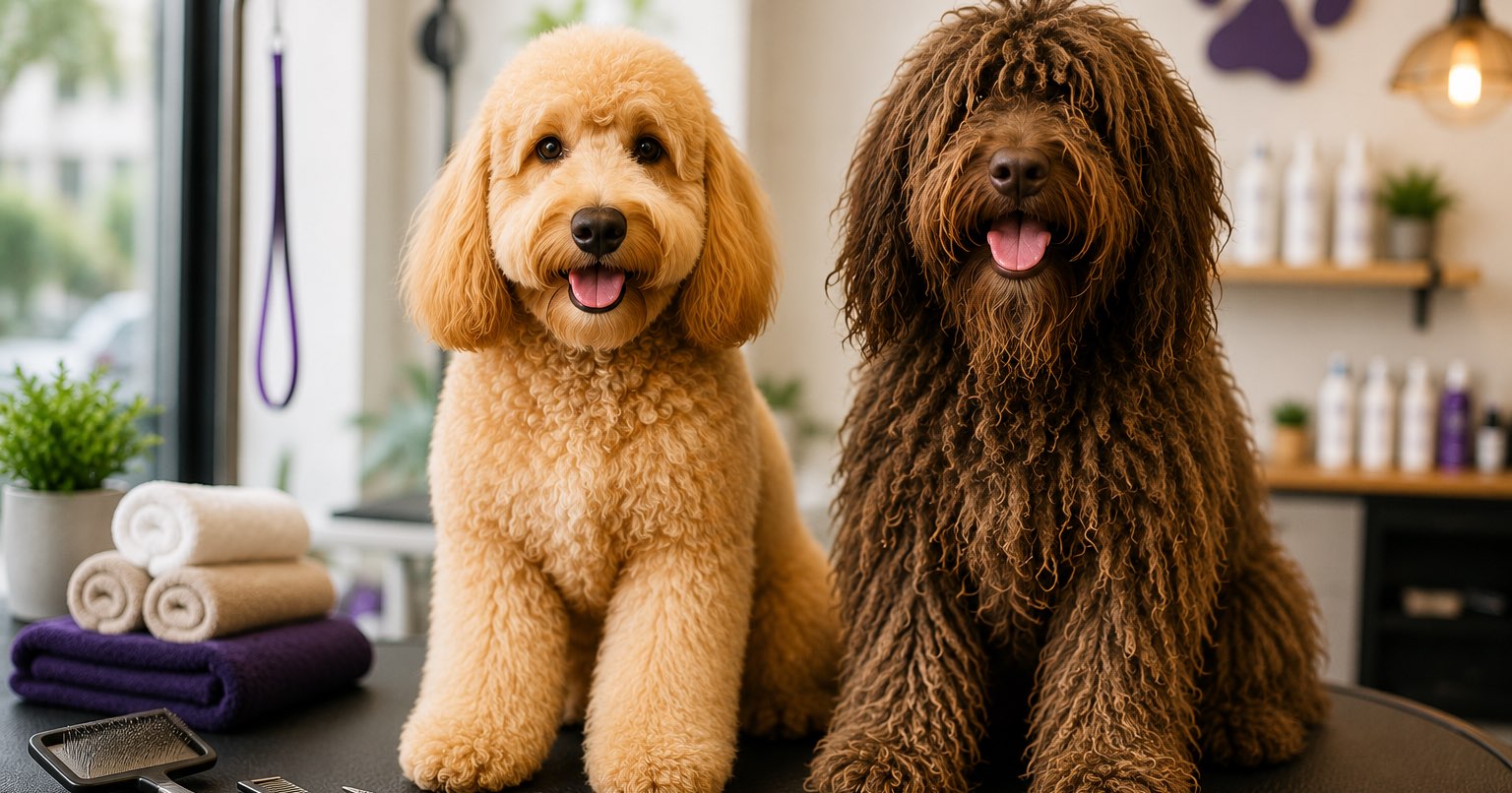
Ask a room of groomers which price causes the most arguments and nobody says the full groom. It's the de-matting fee.
It's the charge that gets questioned at pickup, disputed in the parking lot, and quietly waived by the groomer who doesn't want the confrontation. And it's the one that most reliably separates groomers who make money from groomers who are busy.
Our pricing guide covers how to set your base price by size and coat, and why the add-ons belong on your intake form. This post is about the numbers that go in those add-ons — specifically for the two coats that break a standard price list.
Before the numbers, though, it's worth being precise about what you're actually charging for. A fee you can justify in one sentence is a fee that survives pickup.
What matting actually is — and why it costs
A mat starts as a tangle. Loose hair that should have shed stays trapped in the coat, friction works it tighter, and what began as a knot becomes a dense pad of hair welded close to the skin. Left long enough, the pads join up and the coat stops behaving like hair at all — it moves as a single sheet. That's a pelted coat.
The reason this matters to your price list is that a mat is not a cosmetic problem. It's a medical one.
Mats pull. They tighten against the skin and stay tight, and the dog feels that constantly, not just when you brush it. Mats seal. They cut off airflow to the skin and trap moisture underneath — ideal conditions for bacterial and fungal infection, which is why the skin you uncover is so often raw, sore or weeping. Mats restrict circulation. In severe cases they cut off blood supply to the skin entirely. Around ear tips, where mats form especially tight, the tension pulls skin away from the cartilage hard enough to rupture blood vessels underneath and produce a hematoma. And mats hide things — lumps, parasites, wounds, infections the owner has never seen, because nobody has been able to get to that skin in months.
So by the time a heavily matted dog is on your table, three things are true at once. The dog is in pain before you start. The work is slow, delicate and physically punishing. And you are operating blind against skin that may already be damaged, with the liability that carries.
That is what the fee is for. Not the extra minutes — the pain, the risk, and the skill of working safely against a coat that has become a welfare problem.
Why doodles broke the price list
A standard grooming price list assumes size predicts work. Small dog, less work. Large dog, more work. It holds up fine across most of the breed spectrum.
Doodles broke it.
A doodle is a coat that needs poodle-level work on a retriever-sized body, usually owned by someone who was told the dog was low-maintenance and doesn't shed. Both halves of that sentence cost you money.
The maths groomers describe is stark: you can complete five small dogs in the time one unmaintained doodle takes. If your price list is built on size, you've just sold three hours of skilled work at a ninety-minute rate — and you did it on the appointment that wrecked your back.
The other cost is the one nobody puts on an invoice. Doodle coats demand hand scissoring, which is slower than clipper work and far harder on your hands and shoulders. That's not a preference. That's the finite part of your career being spent, and our pricing guide makes the case for why that has to be priced in.
The three fee models groomers actually use
There's no single industry standard, but published salon pricing lands on three structures. Each is defensible; they suit different businesses.
1. Per-minute. The most common in current published price lists — typically $1 per minute of de-matting or shave-down work, charged on top of the full groom price. Some salons run it as $10–30 per 15-minute block, which is the same idea in coarser units. Practically, most de-matting charges land in the $40–90 range, with light work — ears only, say — coming in at $10–15.
The strength of per-minute billing is that it's self-evidently fair. You are charging for time the dog actually took. The weakness is that you must track it, and a client who watches the clock will argue about the clock.
2. Flat coat surcharge. A fixed fee attached to the coat type regardless of condition — for example $30 on top of the standard price for poodles and doodles at medium size and above.
This is the easiest to quote and the easiest to build into online booking, because it needs no judgment call at the table. It also under-recovers on the genuinely terrible groom and over-recovers on the well-maintained doodle, which some owners will notice and resent.
3. Tiered by matting grade. You assess the coat at intake, assign it a grade, and each grade carries a set fee. It takes the most setup and it's the one clients argue with least, because the grade is visible and the price follows a published rule rather than your mood.
Pro tipWhichever model you pick, write it down and publish it. The fee you can point to on a price list is a policy. The fee you announce at pickup is an opinion, and opinions get negotiated.
Grading matting so the fee isn't arbitrary
The reason de-matting fees get disputed is almost never the amount. It's that the client has no way to check it. A grade fixes that.
A workable four-point scale:
- Grade 1 — surface tangles. Brushes out inside a few minutes. Usually no fee, or the $10–15 light charge if it's localized to ears and armpits.
- Grade 2 — defined mats, skin still reachable. De-matting is viable. Time-based fee applies.
- Grade 3 — dense matting across sections, comb won't pass. De-matting is possible but slow and uncomfortable for the dog. Fee is substantial and shaving is on the table.
- Grade 4 — pelted, coat moves as one sheet. De-matting is off the table. Shave is the only humane option.
Two rules make the grade stick. Assess before the bath, not after — water tightens mats and a Grade 2 becomes a Grade 3 while you're rinsing. And photograph the coat at intake. A time-stamped photo ends the "he wasn't that bad when I dropped him off" conversation before it starts, and it's your evidence if the groom is later disputed publicly.
Many salons pair this with an automatic trigger: for long-haired and double-coated breeds, a de-matting fee is added by default when it's been more than 12 weeks since the last groom. Some go further and set a non-negotiable maximum length — half an inch or shorter — once the gap passes 8 weeks or matting is present. The trigger does the arguing for you, because it was agreed before the dog arrived.
The humane-shave call, and how to price it
At Grade 4 there is no decision to make. A pelted coat cannot be brushed out without hours of pulling on skin that is already inflamed underneath. Shaving is the humane option, and "humanity over vanity" is the phrase the trade has settled on for it.
The judgment call sits at Grade 3, and the honest test is the dog, not the coat. If the dog is panting hard, fighting the process, or shutting down, de-matting has stopped being a grooming decision and become a welfare one. Stop and shave.
Here's where groomers lose money: the shave takes less time, so they charge less for it. That's backwards. What the client is paying for on a pelted dog is not the duration. It's your skill working a blade under a solid mat against skin you cannot see, your liability when the skin underneath turns out to be raw, sore or infected, and your judgment in calling it correctly. That work is worth more per minute than a routine haircut, not less.
Price the shave-down at your de-matting rate. If you bill per minute, the clock runs the same as it would for brushing out.
Heads upThe risk on a pelted dog is real and it lands on you. Skin under a solid mat is frequently damaged before you touch it — sores, hot spots, sometimes a wound the owner never knew existed. Document it with photographs before you start, show the owner at pickup, and never let a shave-down leave your salon without that record.
Get it in writing before the dog arrives
Every recurring dispute in this area comes from the same root: the first time the client heard about the fee was after the work was done.
The single most effective fix is also the least glamorous. Nobody's dog gets touched until the service agreement is signed. Not the first mat, not the first brush stroke — no work starts on an unsigned client.
That sounds heavy-handed for a haircut. It isn't. It's the difference between a fee you can point to and a fee you have to defend.
What the agreement has to say about coats
Three clauses do the work here:
- Matting policy. You reserve the right to shave a severely matted coat, and you will not de-mat against welfare guidelines. The client acknowledges this before the first appointment — which means the shave-down conversation has already happened, in writing, on a calm day.
- Pricing acknowledgment. Prices quoted at booking are estimates and may adjust based on actual coat condition, size or behavior. This one line is what makes a condition surcharge legitimate rather than a surprise.
- Health disclosure. The client confirms what they know about the dog's skin, medical conditions and history — so when you uncover a sore under a pelt, you are documenting a pre-existing problem, not inheriting the blame for it.
The positioning post covers the rest of what belongs in an agreement, and the argument for why a signed one changes how clients treat you. For matted coats specifically, the matting clause will save you more arguments and more bad reviews than any other single thing on this list.
Alongside it, keep the matted pet release — standard practice across the trade — for the individual dog on the individual day: shaving may be necessary, additional charges apply, pre-existing skin conditions may be revealed. Signed at check-in, not at pickup.
The distinction matters. The service agreement is signed once, at the start of the relationship, and sets the terms. The release is per-visit, and records the condition of this dog today.
Make it impossible to skip
The reason groomers don't enforce this isn't that they disagree with it. It's that chasing paperwork at check-in, with a dog pulling on the lead and the next client due in ten minutes, is the easiest thing in the world to skip "just this once."
So take it off the table. In ThePetsMonk you set your service agreement up once with your own terms, and clients e-sign it during their first booking — before they ever arrive. The signed copy is timestamped to their profile, and they never sign again unless you change the wording, in which case the agreement is versioned and re-signed. You can see who has signed and who hasn't at a glance, which means "unsigned" is a thing you notice the day before rather than discover in the doorway. That's part of customer and pet records.
Pair it with a booking flow that quotes the coat surcharge automatically. If a client selects a doodle at booking and sees the correct price before they arrive, nobody has to say a higher number out loud to anyone's face. Configuring price rules by size, coat and breed isn't an admin nicety — it's how you stop being the person defending the fee in the doorway.
Pro tipIf you take one thing from this post, take this: signed agreement before the work starts, surcharge quoted at booking, photos at intake. Those three habits eliminate almost every de-matting dispute you will ever have — and none of them require you to be tougher in the moment.
For the conversation itself — how to explain matting to an owner who thinks their dog is fine — that's its own subject and we'll cover it separately.
When the client refuses to pay
It happens. The dog took two hours longer than the booking, the fee is on the invoice, and the client says no.
Hold the price. You did the work, the pricing acknowledgment is in the signed agreement, and the release was signed at check-in. A fee you waive once becomes a fee that client expects you to waive permanently — and they will tell other clients you waived it.
What you can offer instead is a choice for next time: bring the dog on a four-week schedule and the surcharge disappears, because the coat never reaches the state that triggers it. That reframes the fee as something the client controls rather than something you imposed. For doodle coats, four weeks is the outer limit anyway, not an upsell.
If they refuse the fee and the schedule, you have your answer about whether this is a client worth keeping. The positioning post makes the longer argument, but the short version is that handling the dogs other people won't is one of the few genuinely defensible premium positions in grooming — and it only works if you actually charge for it.
Frequently asked questions
How much should I charge to groom a doodle?
Charge your base price by size and coat, then add a coat surcharge on top. Published salon pricing commonly uses either a flat curly-coat fee of around $30 for medium and larger doodles, or time-based billing at roughly $1 per minute for any de-matting the coat needs. The critical part is that the surcharge is quoted at booking rather than announced at pickup.
Is matting actually harmful to a dog?
Yes — it is a welfare problem, not a cosmetic one. Mats pull constantly against the skin, seal off airflow and trap moisture underneath, which breeds bacterial and fungal infection. In severe cases they restrict blood supply to the skin, and mats around the ear tips can pull hard enough to rupture blood vessels and cause a hematoma. They also conceal lumps, wounds and parasites that nobody has been able to see or reach for months.
What is a de-matting fee and how much is it?
A de-matting fee covers the extra time and tool wear involved in removing mats before a groom can proceed. Most charges land in the $40–90 range, with light work such as ears only running $10–15. The three common structures are per-minute billing (around $1 per minute), a flat surcharge by coat type, or a tiered fee set by matting severity.
Should I charge more for a matted dog even if I shave it?
Yes. A shave-down on a pelted coat takes less time than brushing out, but it carries more skill and more liability — you are working a blade under a solid mat against skin you cannot see, which is frequently damaged before you start. Price it at your de-matting rate rather than discounting it for being quicker.
Do I need a service agreement before grooming a matted dog?
Yes — signed before any work starts, not at pickup. The agreement should carry a matting policy (you may shave a severely matted coat and won't de-mat against welfare guidelines), a pricing acknowledgment (quoted prices are estimates and may adjust for coat condition), and a health disclosure. Signed once at the start of the relationship, it turns a condition surcharge from a surprise into an agreed term. Software that collects the signature during the first online booking removes the check-in scramble that makes groomers skip it.
Can I shave a matted dog without the owner's permission?
Get it in writing first. A signed matted pet release at check-in — acknowledging that shaving may be necessary, that extra charges apply, and that pre-existing skin conditions may be revealed — is standard practice across the trade and is what protects you if the result is disputed. Photograph the coat before you begin.
How often should a doodle be groomed?
Four to six weeks, with four weeks the realistic target for a full coat. Beyond that, matting starts and the appointment changes from a haircut into mat removal. Many salons formalize this by adding an automatic de-matting fee once it has been more than 12 weeks since the last groom.
Why do groomers charge more for doodles?
Because a doodle is poodle-level coat work on a much larger dog. The coat needs hand scissoring rather than clipper work, which is slower and significantly harder on a groomer's hands and shoulders, and it mats faster than most owners expect. In the time one neglected doodle takes, a groomer could complete several small dogs.
Fee ranges in this post are drawn from published salon price lists and grooming policy pages current in 2026. Grooming prices vary widely by region and market — treat these as orientation, then set your own from your costs, as covered in the pricing guide.