You Don't Have a Pricing Problem, You Have a Positioning Problem
New dog groomers underprice because they misread the market. Here is how to position your grooming business so premium pricing stops being a fight.
TL;DR
Most new dog groomers underprice their services — and every experienced groomer will tell them to charge more. But "just charge more" is unhelpful advice unless you understand why customers would pay it. Grooming looks like a commodity from the outside, but from the customer's perspective it isn't: they are handing over a beloved pet to a stranger with sharp tools for several hours. That gap between how the service looks and how it feels is where your pricing power lives. New groomers should not compete on price. They should compete on trust, calmness, communication, and professionalism — most of which is established before the first snip through booking software, written agreements, and a visibly organized business. Get those right and premium pricing stops being a fight.
The Mistake Behind the Mistake
Every new groomer has the same fear.
"What if nobody books me?"
It's why so many new salon owners lower their prices before they've even opened their doors. It feels like the safest decision they can make.
Ironically, it's also the decision they regret the most.
Ask a room of experienced dog groomers what the biggest mistake new business owners make and the answer is nearly unanimous: underpricing. Not marketing. Not equipment. Not client acquisition. Pricing. We heard exactly that when we asked 194 groomers what they wish they'd known before opening — pricing was the regret named most.
The reason it tops every list is that underpricing compounds. Every other problem in a young grooming business gets harder to solve when the margin is too thin. You can't buy the hydraulic table that saves your back. You can't afford insurance, a bookkeeper, or a day off. You can't say no to the aggressive dog or the chronically late client, because you need the money. And once your customers have anchored to a low price, raising it becomes a fight you have to win over and over again.
But here's what most advice misses: underpricing isn't really a pricing mistake. It's a positioning mistake that shows up on the price list.
New groomers price low because they're scared. Scared no one will book them. Scared they're not "worth it yet." Scared to lose the client who's price-shopping. The low number is just the symptom. Fix the fear — and the positioning underneath it — and the price fixes itself.
Why "Just Charge More" Is Bad Advice
Every new groomer has heard it: "Just charge more." Then they open their salon in a town where three other groomers charge $50 for a full groom and PetSmart charges $65, and the advice evaporates on contact with reality.
The problem with "just charge more" is that it treats price as an independent variable. It isn't. Price is a consequence of what you're offering and how obvious that offering is to the customer before they book. If you look identical to the shop down the road and charge 40% more, you will not get booked. That isn't a pricing failure — it's a positioning failure.
Price doesn't create positioning. Positioning creates price.
So the useful question isn't "should I charge more?" It's "what am I offering that the cheap shop isn't, and does the customer know it before they pick up the phone?"
Grooming Looks Like a Commodity — But It Isn't
From the outside, dog grooming looks like a commodity. Dogs go in dirty, dogs come out clean, everyone uses roughly the same shears and shampoos.
From the inside — from the customer's actual lived experience — it isn't a commodity at all. Dog owners are handing over a family member to a stranger with sharp tools for two to four hours. They are anxious, guilty about the state of the coat, worried the dog will be scared, and looking for a reason to trust someone. The commodity framing is what new groomers project onto the market when they're nervous about pricing. Real dog owners don't experience it that way.
That gap — between how grooming looks and how it feels — is where premium pricing lives.
At the low end, grooming really is a commodity, and it's a race to the bottom that a new solo operator cannot win. You don't have the volume, the staff, or the systems to compete with PetSmart on price. Trying to means working 60 hours a week for $35,000 and quitting in three years.
At the middle-to-upper end, grooming is not a commodity. Customers are buying trust, not a haircut. That's where a skilled solo groomer can actually build a career.
The Six Things Customers Will Pay a Premium For
You don't need to be better than the cheap shop on every dimension. You need to be visibly better on two or three. Here are the ones that actually move customers to pay more:
1. The dog comes home calm
This is the single biggest differentiator in grooming, and almost nobody markets it. High-volume shops process 10–15 dogs a day, kennel them for hours between bath and finish, use loud dryers, and rush. If your dog leaves your salon relaxed instead of shaking, the owner notices immediately — and tells everyone they know.
One-on-one appointments (you groom the dog start to finish, no cage time, no hand-offs) is a genuine product difference, not a marketing story. It's also the easiest thing for a new solo groomer to offer, because you're already working alone.
2. Real expertise on their specific breed
Most cheap shops do a generic "puppy cut" on everything that walks in. If you can properly execute a breed-appropriate trim on a wire fox terrier, a schnauzer, a standard poodle in continental, or (most importantly today) a doodle that hasn't been butchered — you are simply not in the same market as PetSmart. Breed-specific competence is the clearest premium signal there is.
If you don't want to specialize, at minimum become visibly excellent at doodles. They are the largest and most-poorly-groomed segment in the market right now, and their owners will pay real money for someone who understands their coat.
3. Professional communication
Photos before and after. A text when the dog is dropped off, mid-groom if there's an issue, and when the dog is ready. A written record of what you did and what the coat needs at home. Honest conversations about matting instead of silently shaving.
Owners have been trained by bad groomers to expect zero communication. Beating that bar is cheap and enormously effective.
4. A space that signals care
Clean. Doesn't smell. Calm music. No visible chaos from the front. You don't need a fancy build-out — you need it to not look and sound like a kennel. The first ten seconds when a client walks in decides whether your price feels reasonable or offensive.
5. Boring reliability
You start on time. You finish when you said you would. You don't cancel. You don't lose their appointment. In a trade where flakiness is endemic, boring reliability is a premium feature that customers will pay for without even realizing what they're paying for.
6. Handling the dogs other people won't
Seniors. Anxious dogs. Dogs that need medicated baths. Dogs with mobility issues. These owners are desperate and price-insensitive. If you become known as the groomer who is patient with the arthritic 14-year-old shih tzu, you will never lack for clients — and they will pay whatever you ask.

The Unsung Differentiator: Your Booking and Communication Experience
Here's what most new groomers miss entirely: the booking experience is the first grooming decision the customer makes about you — before you've touched a single dog.
Think about what a typical cheap-shop booking flow looks like. Customer calls. Phone rings out. They leave a voicemail. Someone calls back three hours later sounding harried. "What kind of dog? When do you want to come in?" They get a time. They hang up. There's no confirmation, no reminder, no idea what it'll cost. They arrive and get handed a photocopied form on a clipboard.
That entire experience says: we are winging this. And the customer's brain — correctly — extends the impression to the grooming itself. If the booking is chaotic, the scissors probably are too.
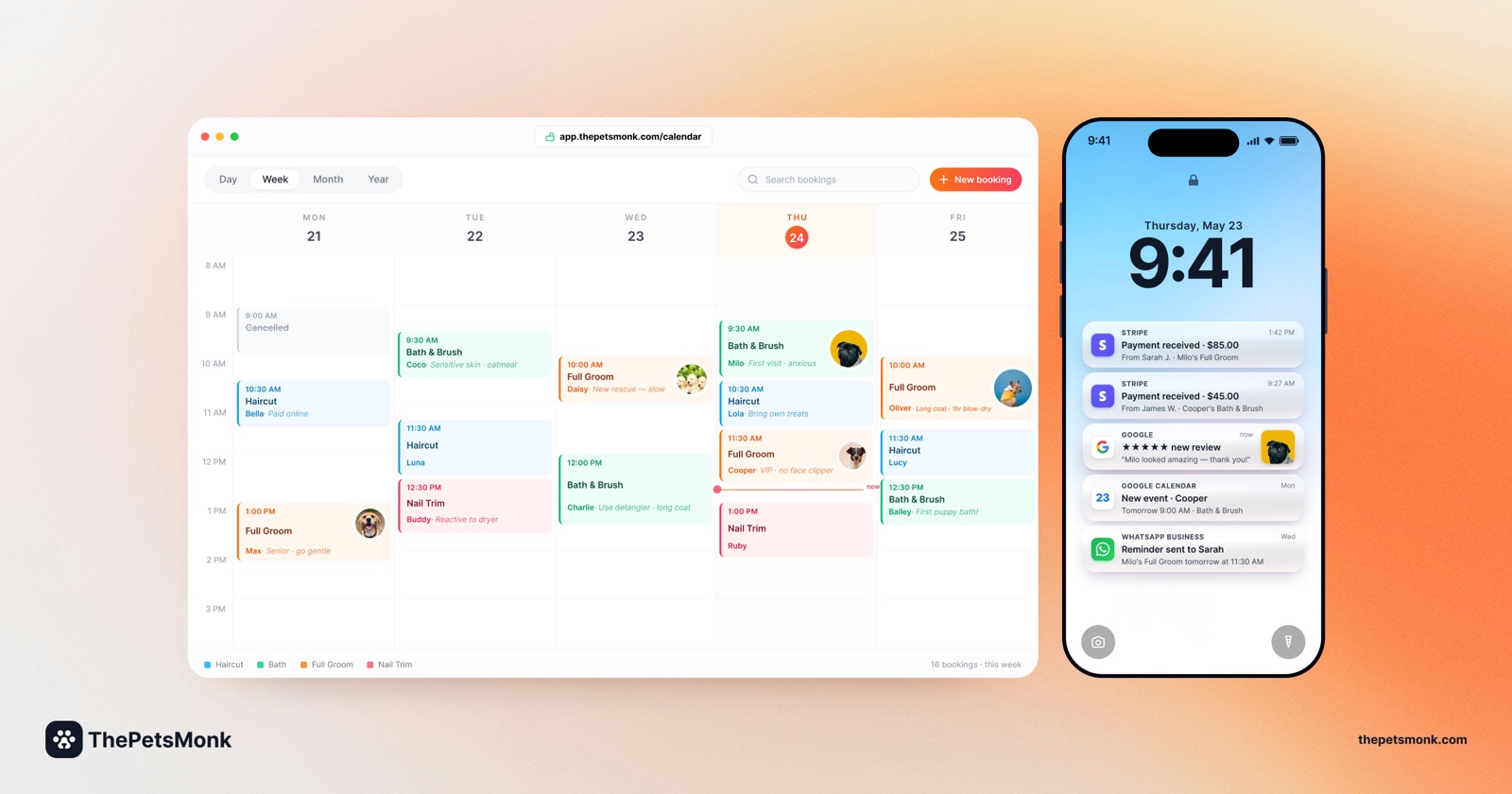
Now flip it. Customer taps a "book" button on your Instagram. Sees your services and starting prices. Picks their dog's breed and size from a dropdown. Picks a slot from a live calendar. Gets an instant confirmation email and text. Gets a link to complete your intake form and service agreement before the appointment. Gets a reminder 48 hours out and again the morning of. Gets a "your dog is ready" text with a photo when it's done.
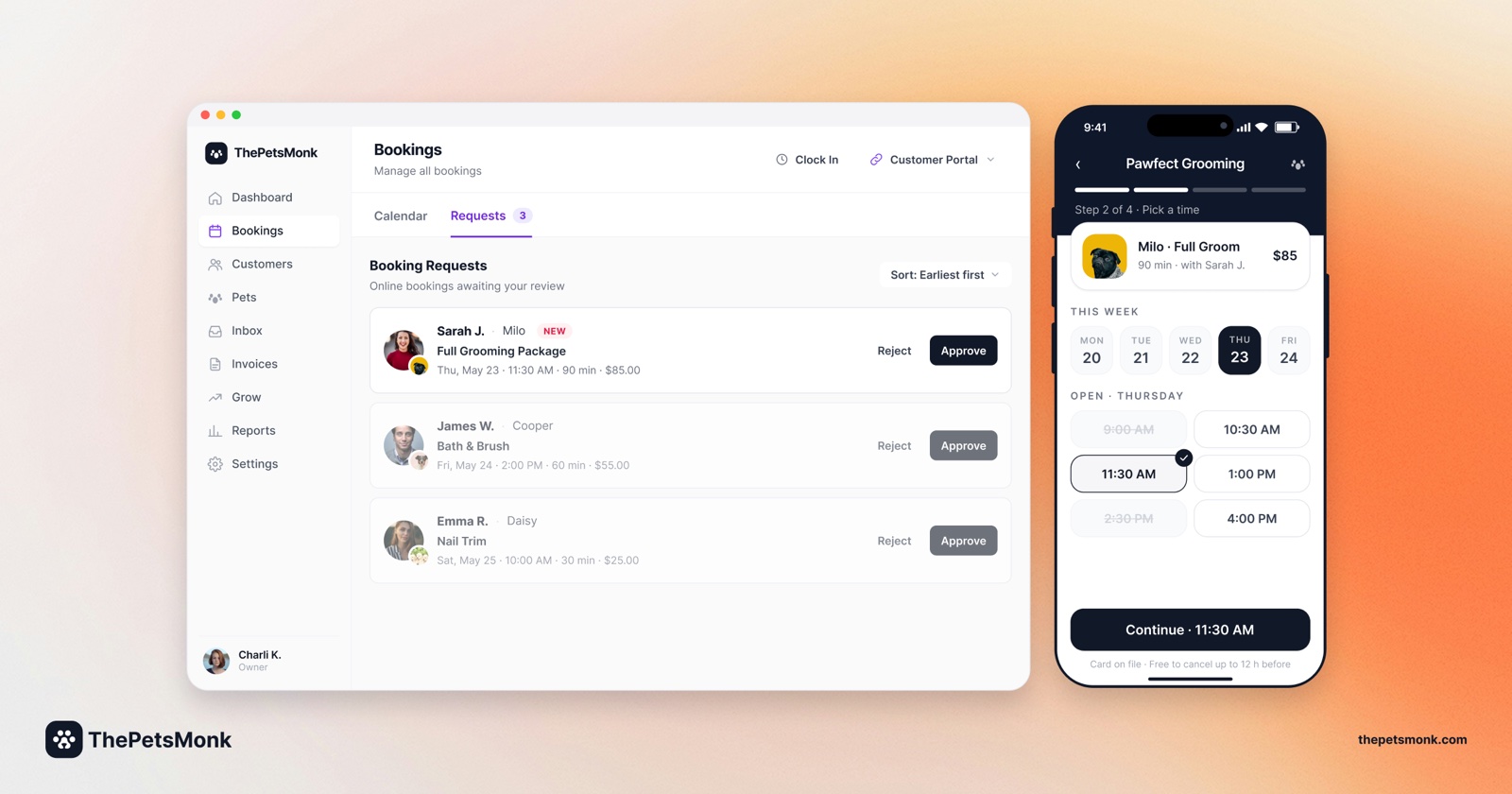
That entire flow costs about $39 a month in software. And it is doing enormous work for you: it is telling the customer this person runs a real business, my dog is going somewhere organized, the price won't be a surprise, and I won't have to chase them. You have justified a premium price before they've even met you.
Put the numbers in perspective. A single missed $85 appointment costs more than a full month of most grooming software subscriptions. Software that prevents even one no-show a month has paid for itself. Software that helps you charge $10 more per groom, across 60 appointments, pays for itself sixteen times over.
Customers don't compare prices. They compare confidence.
What Modern Grooming Software Actually Does For You
New groomers often think of booking software as "the thing that shows my calendar online." That's a fraction of what it actually is. Used properly, it becomes the operational backbone of your positioning strategy. Here's what to look for — and why each one is a positioning tool, not just an admin tool:
Configurable pricing by size, coat, and breed. Toy poodles, standard poodles, and matted doodles should not cost the same thing. When the correct price is calculated automatically at booking, no one on your team forgets or quotes wrong. It also removes the emotional labor of quoting prices out loud — which is where a lot of new groomers cave and give unintended discounts.
Deposits at booking. Even a $20 non-refundable deposit filters out tire-kickers and cuts no-show rates dramatically. It also signals professionalism: real businesses take deposits, hobbies don't.
Recurring appointments. When a client rebooks their next four appointments before leaving, you have locked in months of revenue and eliminated their need to think about grooming at all. That's the customer relationship you want — automatic.
Memberships and packages. Monthly grooming memberships smooth out revenue, guarantee retention, and give customers a reason to pick you over the salon down the road. A "6 grooms + 1 free" package does the same thing.
Waiting lists. When a client cancels last minute, waiting-list automations fill the slot before you even see the notification. That single feature is often the difference between a $0 afternoon and a $200 one.
Automated review requests. After every appointment, an automated message asks happy clients to leave a Google review. This is how you build social proof at scale without ever having to ask in person.
Customer and pet notes. "Cooper is reactive to the dryer." "Bella has sensitive skin — use oatmeal shampoo." "Milo's first visit — go slow." These notes are the difference between feeling like a regular and feeling like a stranger. Every returning customer should feel remembered.
Vaccination reminders. Automatic alerts when a rabies or bordetella vaccine is expiring. This keeps you professional, keeps you compliant, and gives you a natural reason to reach out to the customer between appointments.
Birthday reminders and win-back campaigns. A birthday message for the dog. A "we miss you" nudge when a client hasn't booked in eight weeks. Small automated touches that make the customer feel seen — and rebook.
None of these features is grooming skill. But together, they create a professional experience the customer feels in every interaction. That is what premium pricing is actually being paid for.
The Service Agreement Is Not Paperwork — It's a Signal
A signed service agreement is not primarily a legal document (though it is that too). It's a signal. It tells the customer: this is a professional relationship with terms, not a favor I am doing you.
Have new clients sign it digitally at booking — most booking platforms handle this natively. Once. Kept on file. Never has to be a conversation again.
What belongs in it:
- Cancellation and no-show policy with actual teeth. 24-hour notice required. Deposit forfeited or card charged 50% for no-shows. Without this, your calendar becomes a suggestion.
- Matting policy. You reserve the right to shave down severely matted coats and will not de-mat against welfare guidelines. The customer acknowledges this in writing before the first appointment. This clause alone will save you more arguments and bad reviews than anything else you do.
- Behavior and safety clause. You may end a groom early and charge a partial fee if a dog is aggressive or unsafe. The customer agrees to disclose known behavioral issues honestly.
- Health disclosure. The customer confirms vaccinations, discloses medical conditions, seizures, hot spots, and senior status. You may decline service for undisclosed issues.
- Photo release. You can use before-and-after photos on social media. This is your best marketing and you want it locked in on day one.
- Late pickup policy. After a defined window past ready-time, a fee kicks in.
- Pricing acknowledgment. Prices quoted are estimates and may adjust based on actual coat condition, size, or behavior.
None of this is grooming skill. It costs almost nothing. But together with your booking flow, it creates the frame in which your premium pricing makes sense. The cheap shop cannot copy this without becoming a different kind of business — one that has to think of itself as a business rather than a job. Most of them won't.
A Practical Pricing Framework for New Groomers
Now that the positioning is right, here is how to actually set prices. (For the full pricing playbook — market ranges, the cost-up method, and raising rates — see our pet grooming pricing guide.)
Start from your costs and your desired income, not from what the shop down the road charges. Different markets vary dramatically — a rural town in the Midwest and central Austin, or a suburb of Sydney and downtown Manchester, are not comparable pricing environments. What matters is that your price reflects the experience you're offering. Calculate your rent, insurance, supplies, and equipment amortization. Add the income you actually want to earn. Divide by the realistic number of appointments you can do in a month. That's your floor.
Once you have your floor, look at the local market. If your number lands 15–25% above the local average — great, that's typically where a professionally-positioned solo groomer belongs. If it lands below the local average, either your desired income is too low or your assumptions about appointment volume are unrealistic. If it lands well above the average and your market can't support it, you'll need to either raise the ceiling of what you offer (specialization, senior dogs, premium coats) or move to a market that can. Use a tool like the ThePetsMonk revenue calculator to run these numbers before you set your first price list.
Price the groom, then add for the work. Base price for breed and size. Add for coat condition, behavior, size beyond standard, and time. Write these add-ons into your intake form so the customer sees them before you touch the dog. This is how you stop absorbing the cost of every difficult groom.
Raise prices every 6–9 months in small increments. 5–10% at a time. Existing clients tolerate small, regular increases far better than sudden large ones. Announce them in advance by text and email. Frame them around what the customer gets — more time per appointment, better products, continued availability — not around your costs.
Never advertise the lowest price. You are not competing on price. Your website, Instagram, and Google listing should lead with what makes you different — small-batch grooming, one dog at a time, no cage drying, breed-appropriate cuts — not with a number.
Charge a deposit at booking. Even $20 non-refundable. It filters out tire-kickers, dramatically reduces no-shows, and again — signals professionalism.
The Positioning Checklist
Before you open the doors, work through this list. Anything unchecked is a positioning gap the customer will feel — even if they can't articulate why.
Before opening your salon:
- Professional logo and consistent brand colors
- Booking software with a live online calendar
- Digital intake forms
- Signed service agreement on file for every client
- Deposits enabled at booking
- Automated appointment reminders (SMS + email)
- Pricing configured by size, coat, and breed
- Google Business Profile claimed and complete
- Instagram account with a booking link in the bio
- Portfolio of before/after photos ready to post
- Vaccination tracking system in place
- Written cancellation, matting, and late-pickup policies
- Liability + care/custody/control insurance
- Separate business bank account
- Price list finalized and calculated from actual costs
If you can tick every box, your positioning is doing the pricing work for you. If you can't, that's your to-do list.
What to Do in Your First 90 Days
If you're opening a new salon and want to get this right from the start, here is the sequence:
Days 1–30: Set the frame.
- Pick a booking platform and get your services, hours, and pricing loaded in.
- Write your service agreement and load it into the platform.
- Set your prices based on your actual costs and desired income, then position relative to the local market.
- Build a simple website or Instagram-linked booking page that leads with your differentiators, not your prices.
- Get liability and care/custody/control insurance.
- Open a separate business bank account.
Days 31–60: Deliver the experience.
- Groom every dog like it's going in a portfolio. Photograph every one, before and after.
- Send a "your dog is ready" text with a photo, every time.
- Send a thank-you note after the first appointment.
- Ask happy clients for Google reviews, directly and by name — or set up automated review requests so it happens without you thinking about it.
Days 61–90: Tighten the operation.
- Review no-shows and cancellations. Enforce your policy on every one.
- Fire the two worst clients. There will be two. You will know who they are.
- Raise prices 5% if your calendar is filling.
- Start tracking which clients rebook and which don't. The premium ones will. That's the confirmation your positioning is working.
Frequently Asked Questions
Why do new dog groomers underprice their services?
Because they are afraid — afraid no one will book them, afraid they aren't "worth it yet," and afraid to say no to any client because they need the money. Underpricing is a mindset problem that shows up on the price list.
How much should a new dog groomer charge?
Rather than picking a number from what the shop down the road charges, calculate your prices from your costs, desired income, appointment length, and the experience you're offering. Then compare against the local market so you're positioned intentionally, not reactively. In most markets, a professionally-positioned solo groomer lands 15–25% above the local average.
Isn't dog grooming a commodity service?
Only at the low end of the market. In the middle-to-upper end, customers are not buying a haircut — they are buying trust, calm handling, professionalism, and a visibly organized business. Those are not commodity attributes and they command real premiums.
Why would a customer pay more to a new groomer?
Because the "new" part is invisible if the rest of the experience is professional. Customers cannot evaluate scissoring skill before they book. They can only evaluate everything around it — the booking flow, the agreement, the space, the communication, the calm handling of their dog. Get those right and pricing follows.
Can grooming booking software handle different prices for different breeds and sizes?
Yes — and it should. Good grooming platforms let you configure pricing rules by size, coat type, and breed, so the correct price is calculated automatically when a client books. This prevents undercharging, eliminates awkward pricing conversations at pickup, and ensures anyone on your team is quoting the same numbers you would.
How often should a new groomer raise prices?
Every 6–9 months, in 5–10% increments, announced in advance. Small regular increases are much better tolerated than sudden large ones, and they train your client base to expect that your pricing reflects a professional business, not a hobby.
Should a new groomer take every client who calls?
No. Firing bad clients early is one of the highest-leverage moves a new groomer can make. Aggressive dogs, chronic no-shows, owners who refuse to follow bathing schedules, and clients who argue about pricing will drain far more time and energy than they generate in revenue.
Is grooming software worth the cost for a solo groomer?
Almost always yes. A single missed $85 appointment costs more than a full month of most grooming software subscriptions. Software that prevents one no-show, fills one cancellation from a waiting list, or nudges one lapsed client to rebook has already paid for itself. For a solo groomer, it's the closest thing to hiring an assistant that doesn't cost a salary.
The Bottom Line
The best groomers don't charge more because they're more confident.
They're more confident because they've built businesses that justify charging more.
Every online booking. Every appointment reminder. Every signed agreement. Every clear policy. Every on-time pickup. Every thoughtful follow-up.
Every one of those moments tells the customer the same story:
"Your dog is in the right hands."
And when customers believe that, price stops being the deciding factor.