What 194 Groomer Comments Reveal About Opening a Pet Grooming Business
We asked working groomers what they wish someone had told them before opening. Their answers were about pricing, their bodies, boundaries and hiring.
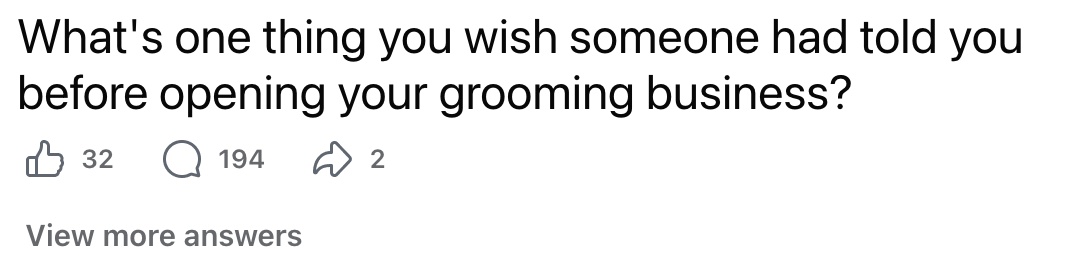
We asked a simple question in a groomers' community: "What's one thing you wish someone had told you before opening your grooming business?"
The question drew 194 comments. Almost none of them were about grooming.
One answer came back more than any other, in a dozen different phrasings: you are charging too little. "Charge more." "Charge your worth." "Prices are too low." Roughly one in five answers was about pricing — more than any other single theme, and the one described with the most regret.
You know that number in your head you need to hit in order to be able to make a decent income? Triple it.
Rachelle M.
The rest talked about their backs, their boundaries, their accountants, and the day they realised they could not switch off. Several have been doing this for twenty, thirty, even forty years. What follows is their advice, in their own words.
What is the biggest mistake new grooming business owners make?
Underpricing — by a wide margin. No other mistake came close in how often it was raised or how much regret came with it. The reason it tops the list is that it compounds: every other problem on this page is harder to solve when the money is too thin. You cannot buy the hydraulic table that saves your back, hire help, pay a decent bookkeeper, or take time off if the margin was never there. And once clients anchor to a low price, raising it becomes a fight you have to win over and over.
Beyond pricing, the answers clustered into eight lessons: what to charge, how to protect your body, where to draw boundaries, how to choose clients, whether to hire, the money that has nothing to do with grooming, what equipment to buy, and how to survive the mental load. Here they are, in the groomers' own words.
1. Underpricing is the mistake groomers regret most
The advice was blunt and nearly unanimous — Suzanne C., Catherine H., Jill L., Mary M., Sam H. and a dozen others all said a version of the same thing. Nobody in the thread wished they had charged less.
One groomer put an actual figure on it: prices should be roughly $40–60 above local industry standard, "because no one raises prices like they should."
And it works. Kaley Z. described what happened when she stopped competing on price:
Just because everyone else in town is dirt cheap, doesn't mean you need to be. My prices are now almost double compared to others and I'm booked out 9 weeks.
Kaley Z.
The trap is starting low. "It's really hard to start low and then hike your prices up," one commenter warned. Sam H. agreed: "Set your prices correctly — you'll have a harder time raising them to where they need to be otherwise."
Not everyone agreed on how far to push. Sharon E. offered the counterpoint:
I agree don't undercharge, but also don't overcharge. Keep prices reasonable and affordable for your customers, who will then be able to come more often — which is a win-win for you, the customer and the dog.
Sharon E.
If you want the full playbook on what to charge and how to raise rates, see our pet grooming pricing guide — or run your numbers with the revenue calculator. And if "just charge more" has never felt like enough of an answer, we wrote a full guide on why underpricing is really a positioning problem.
2. Your body will send you the bill later
This was the second-loudest theme, and by far the most painful to read. Groomers did not describe aches. They described injuries that ended, or are ending, their careers.
I'm 32 and I'm going to hospital for scans on my bad back and losing strength in my legs. That's what 13 years of doing big dogs has done.
Samantha G.
Mary M., after 29 years: "I wonder why I am so damaged. Lifting 40kg dogs will do that. Get a lift table." Nicola D., after 15: "I'm getting told I won't be able to do this job much longer, as my neck, shoulders and back are getting ruined." Joan D. put it in one line: "That I was going to get arthritis and not be able to work anymore."
Andrea F. has been grooming 30 years: "I wish I would have taken better care of my back — forced myself to stop during the day and stretch."
Dena C., at 41 years in, framed it as a purchase decision:
They may be costly, but they will save your back in the long run. Whatever you can do to take care of your body, do it — because when you get to 50, 60 or older, you will regret that you didn't.
Dena C.
The specific kit named repeatedly: hydraulic tables, lift tables, adjustable tubs, cordless clippers, ear protection and masks.
There was one counter-example, and it is instructive. Charmaine C., 20 years in, says she is in the best shape of her life — because she treats recovery as a line item: massage every one to three weeks, resistance training two to five times a week, for over ten years.
3. Boundaries — and a second phone number
Ask groomers about boundaries and they get very specific, very fast.
You better set boundaries and be quick about it, or you will get walked on. It's a lot harder to set them once people are accustomed to pushing them.
Colleen M.
The most actionable tip in the entire thread was about phones. Christine H.:
Have a separate work phone to your personal phone. People will ring you at 2am.
Christine H.
Shelly S. learned the same lesson the hard way: "Don't use your personal cell as the shop number. Thirteen years later I rarely answer my own cell unless it's family or friends."
The rest of the boundary advice was equally concrete:
- Set hours and hold them. "Set your hours and NEVER EVER budge," wrote Stephanie E.
- Stop filling every cancellation. As Tilden S. put it, "you don't always have to fill the cancelled appointment — it's nice to have a few hours to do nothing."
- No free work for friends and family. Debbie R. and Donna S. both raised it unprompted.
- Don't take every dog. "Set boundaries and don't take on EVERY dog," said Krystal B.
- Stop being a yes person. "I still can't stop that one yet," admitted Emma L. "Working on it."
Laura D. summarised the underlying rule: "You cannot make everyone happy. Don't sacrifice your mental or physical health trying."
4. The owners are harder than the dogs
Almost nobody complained about difficult dogs. Nearly everybody complained about difficult people. "People are crazy," wrote Kathleen D. "How bloody awkward some customers are," said Glenys B. "How difficult people can be," added Sharonne M.
People are the hardest part of pet grooming. Some owners will make you angry, some will make you sad, some will make you question your sanity… The dogs are generally less problematic.
Sienna B.
The practical response was to be selective from day one — about owners, not just dogs.
Be fussy about the clients you accept — both the dogs and, more importantly, the owners.
Jay L.
Brittan R. described reaching that point: "I'm finally booked out enough and getting enough new clients that I'm weeding out the clients that don't bring happiness." Judith K. was shorter: "Customers are customers, NOT friends."
5. Most of them would not hire again
This is where the thread was most emphatic — and it cuts against the usual advice to scale.
A striking number of experienced groomers said the growth move was to stay small, go mobile, or work from home. Ty B. was the bluntest:
Do not open a brick and mortar. Do house call, or set up in your basement. Your overhead will be so much less, and you'll make so much more. You don't want employees.
Ty B.
Amanda G. tried it both ways:
I did a big salon for a couple of years, and then went back to doing it alone. I couldn't keep my doors open and pay myself too.
Amanda G.
Lisa V. and JoJo L. both landed on "go mobile and work alone." One commenter said plainly: "Employees can suck the life out of you in more ways than one."
There was a real counter-position. Logan B. argued the opposite case: "Hire good teammates, good software, a good CPA/bookkeeper, and stay positive. Create policies, and stick to them." Jordan C. offered the middle path — "wait until you can hire help."
Where everyone agreed was how to hire. Megan F.: "Don't hire your best friend to work for you. Train your next person — don't just hire someone who thinks they want to do it." Sara W. extended it beyond groomers: "Be careful choosing who you employ — groomers, accountants, bookkeepers."
The honest summary: hiring is the most divided question in grooming, and the people who regret it regret it loudly. If you do build a team, staff scheduling is where the workload actually lands.
6. The money that has nothing to do with grooming
Groomers were unanimous that the business side blindsided them — and taxes were the specific villain.
All the TAXES! Sales tax, employee taxes, annual taxes, business personal property taxes, etc.
Natalie H.
Sherrie S.: "The financial end of it is the hardest part to manage. You have to prioritise it as equally important as everyday working." Lynnetta W. added a warning worth its own headline: "Having the wrong accountant could cost you your business."
Denise M. found that generic help wasn't enough:
I had a bookkeeper and a CPA, but they weren't strong in the service industry — which is different to a regular office-type business. I realised all of this in my third year and wish I'd found my support sooner.
Denise M.
Debbie P. shared the only explicit formula in the thread: 33% to the employee, 33% to the owner, 33% back into the business. Carolyn B. offered the first question to answer: "Do your budget — what does it cost you to open your doors?"
Jaye W. tied it together: "Get an accountant, take some business and tax seminars. Don't treat dog grooming like a hobby gone public."
Two groomers raised something almost never discussed in this industry:
Save for retirement — you're going to need it.
Tonia B.
"Get yourself a pension," added Alison H. In a trade where the work is physically finite, that is arguably the most important financial advice on this page. Getting payments and invoicing under control is where that visibility starts.
7. Buy the expensive tools once
Cheap equipment was described, repeatedly, as a false economy.
Don't cheap out on equipment and tools. Upgrading as you grow ends up costing so much more, and sooner than you'd think.
Chechie G.
Tanya W. framed good equipment as a revenue tool, not a cost: "Your equipment is everything. The better, the more powerful, the sharpest, the most convenient — the faster money maker you'll be." Tilden S. was specific: "Buy the expensive tools and generators. The cheap ones won't last long."
The shopping list that came up most: hydraulic table, adjustable bath, cordless clippers, ear defenders, masks.
8. Burnout, loneliness and grief
The last theme is the one no business guide mentions, and it appeared again and again.
Burnout is fast. "Balance life and business — burnout is very real," wrote Cheryl M. One groomer warned it "can happen fast," alongside a caution about a rival groomer actively trying to sabotage her business.
The work is lonely. Kaity L. wrote four words that are easy to miss: "It gets very lonely." It is the quiet cost of all that "go mobile, work alone" advice, and worth planning for.
And there is grief. Andrea M. raised what may be the truest thing in the thread:
Be prepared to deal with grief over losing pets as they age and pass. You take care of one long enough, it takes a piece of your heart too when they cross the bridge.
Andrea M.
Charmaine C. described how total the mental load becomes:
I cannot truly switch off unless I leave the country. Make sure you love what you do, because it can completely and utterly imprison you.
Charmaine C.
The remedies groomers actually named were unglamorous and scheduled: book time off a year in advance (Becky G.), take four-day weekends and a week off quarterly (Megan F.), a monthly massage, and — Christine H. again — "when you have a day off, make it a day off."
Would they do it again?
Not all of them. A couple said flatly "don't do it," and one advised keeping grooming as a hobby instead. That belongs in any honest summary of what groomers said.
But most of those describing the damage are still grooming. Tracie W., 21 years in: "Everyone did say don't — but I still did, and still am." Tanya W. wished she had started sooner. And KJ L. offered the closing argument:
Believe in yourself and what you are doing. Know that it matters, no matter who tries to convince you that you are replaceable. If you love what you do and love the animals you do it for, then you are not.
KJ L.
What groomers said most often, at a glance
| Theme | What they actually said | What to do about it |
|---|---|---|
| Pricing | "Triple it." "Charge your worth." | Set profitable prices from day one; raising later is far harder |
| Physical health | "13 years of big dogs" ended a 32-year-old's fitness to work | Buy hydraulic and lift tables early; schedule recovery like an appointment |
| Boundaries | "People will ring you at 2am" | Separate work phone, fixed hours, no free work |
| Clients | "Be fussy — especially about the owners" | Screen owners, not just dogs |
| Hiring | "I couldn't keep my doors open and pay myself too" | Stay solo longer than feels ambitious; never hire friends |
| Finance | "The wrong accountant could cost you your business" | Service-industry bookkeeper, know your overhead, save for retirement |
| Equipment | "The cheap ones won't last long" | Buy quality once |
| Mental load | "It can completely and utterly imprison you" | Book time off a year ahead |
Frequently asked questions
What is the biggest mistake new grooming business owners make?
Underpricing. New owners set prices low to attract clients, then find increases painful once customers have anchored to the cheap rate. Experienced groomers overwhelmingly advise starting higher — one suggested tripling the figure you first think of, and another charges nearly double the local rate while staying booked nine weeks out.
Is pet grooming physically demanding?
Yes, and the damage is cumulative. Groomers reported career-limiting injuries to backs, necks, shoulders and hands after 13 to 30 years, including arthritis and loss of leg strength. Hydraulic tables, lift tables, adjustable tubs, ear protection and a genuine recovery routine were the most recommended protections.
Should a new groomer hire staff right away?
Most experienced groomers said no. Many advised staying solo, going mobile, or working from home for longer than feels ambitious, citing payroll taxes, management load and overhead — several who ran larger salons returned to working alone. Those who do hire consistently warn against hiring friends.
How should a grooming salon set prices?
Prices should cover labour, overhead, equipment, taxes and profit, plus the physical wear the work causes. One commonly cited benchmark was $40–60 above the local standard rate; one owner splits revenue 33% to staff, 33% to the owner and 33% back into the business.
Do groomers need to plan for retirement?
Yes, and it is widely overlooked. Because grooming is physically finite — many groomers cannot work into their sixties — experienced owners specifically advised setting up a pension or retirement savings early, alongside a bookkeeper who understands service businesses.
Do grooming salons need software?
It helps most with the parts groomers said were hardest: enforcing policies, holding hours, tracking money and reducing admin. Software will not set your prices or your boundaries — but it makes both easier to stick to.
About this article
The quotes here come from the 194 comments on a single question posted in a groomers' community: "What's one thing you wish someone had told you before opening your grooming business?" Comments are quoted as written, with light edits for spelling and length only. Contributors are identified by first name and last initial.